


Weak oil revenues persist as sanctions continue reshaping export structure
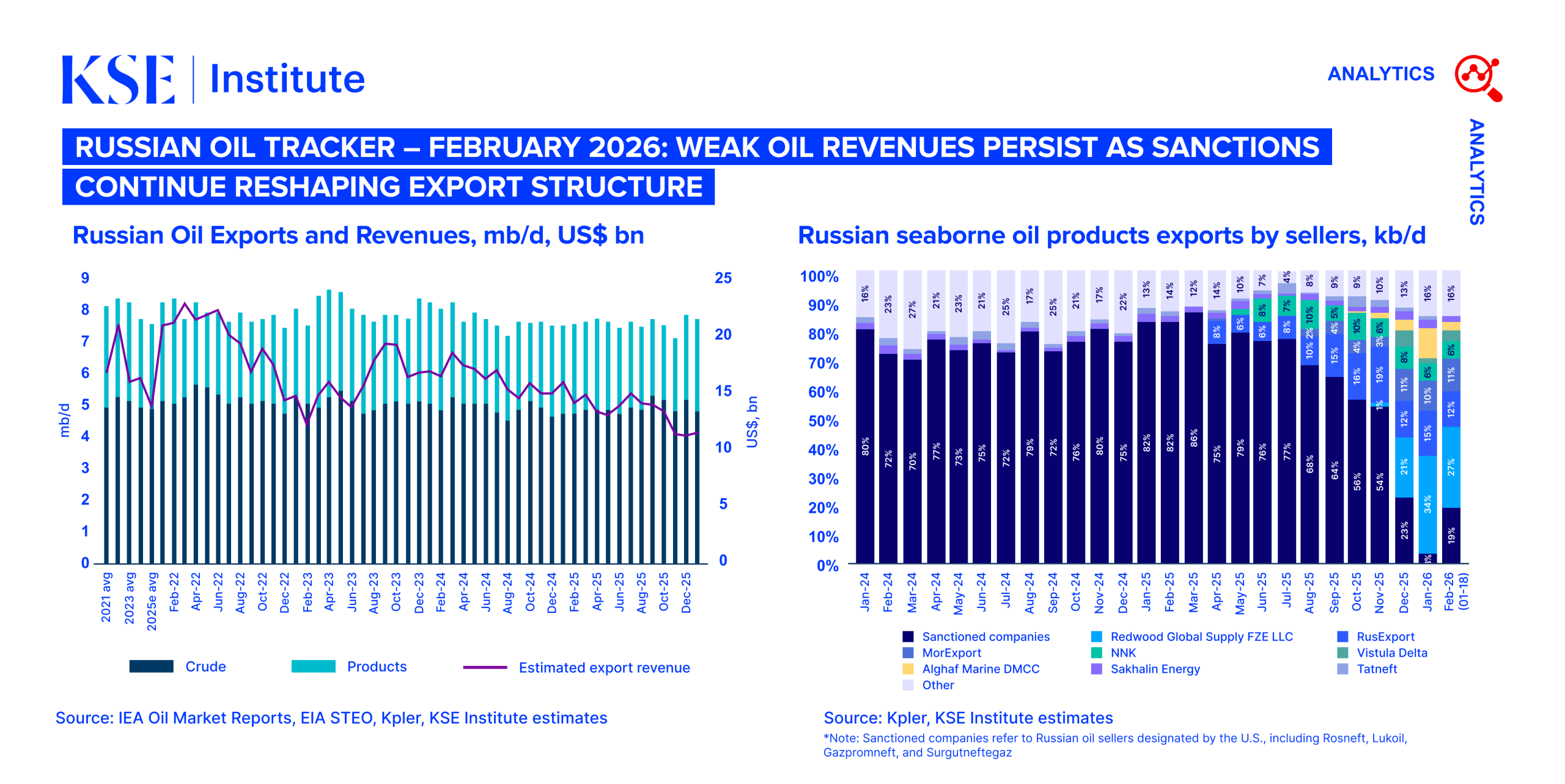 In January 2026, Russia’s oil export revenues remained largely unchanged compared with December, totaling $11.1 billion. This represents an increase of just $0.1 billion MoM but remains $4.6 billion lower YoY, according to the February edition of the Russian Oil Tracker by KSE Institute. A modest increase in export volumes of around 0.1 mb/d offset further declines in prices. Crude oil export revenues amounted to $6.6 billion, while oil product revenues totaled $4.5 billion.
Russian seaborne oil exports decreased by 1% MoM but remained 4.5% higher YoY. Tankers insured by the International Group of P&I Clubs carried only 20% of crude oil exports and 74% of oil product exports, highlighting the continued shift toward alternative shipping arrangements.
At the same time, the structure of Russian oil exports has changed significantly following US sanctions. The combined share of Rosneft, Lukoil, Gazprom Neft, and Surgutneftegas in seaborne crude exports fell from 75% in 2024 to just 19% in January 2026, while their share in oil product exports declined from 48% to 11%. New intermediaries have taken over a large share of export operations. In particular, UAE-based trader Redwood Global Supply FZE LLC accounted for 44% of Russia’s crude shipments to India in January.
China remained the largest buyer of Russian seaborne oil, importing around 2.1 mb/d — the highest level since November 2025 — representing approximately 18% of the country’s total imports. Meanwhile, exports to India totaled around 1.2 mb/d, 32% below the average level observed in 2024-2025. As a result, Saudi Arabia overtook Russia as India’s largest oil supplier.
Sanctions are also complicating Russia’s ability to sell its crude and oil products. Oil product volumes on water increased to 97 million barrels, up from 62 million barrels in October 2025, while crude oil volumes on water remained persistently above 150 million barrels.
The shadow fleet remains a key instrument for Russian oil exports. In January 2026, 166 shadow fleet tankers were involved in transporting Russian oil, of which 96% were over 15 years old. Despite sanctions, 140 of the 621 tankers designated by at least one jurisdiction continued loading Russian oil at Russian ports. In February, additional sanctions were imposed by the United Kingdom (48 tankers), Canada (98), Australia (59), and New Zealand (97), increasing the number of tankers designated by all six coalition jurisdictions to 36.
Prices for Russian oil remain low. Average Urals FOB prices increased by around $2/bbl MoM to approximately $40/bbl, remaining well below the EU’s revised price cap. ESPO FOB Kozmino traded at around $48.3/bbl, while its discount to Brent widened by approximately $3/bbl. Both premium and discounted oil products were also traded below their respective price caps.
According to KSE Institute estimates, under current price caps and sanctions enforcement, Russia’s oil export revenues could decline from $160 billion in 2025 to $115 billion in 2026 and $113 billion in 2027. If discounts to Urals and ESPO widen to $25/bbl and $15/bbl respectively, revenues could fall to $82 billion in 2026 and $66 billion in 2027. Under weak sanctions enforcement, revenues could remain higher, at around $129 billion in both 2026 and 2027.
Contacts