


Oil Revenues Rebound as Prices Soar; Seasonal Budget Surplus Reduces Fiscal Pressures; Inflation Halts Rate Cuts
 KSE Institute has published the October edition of its Russia Chartbook, “Oil Revenues Rebound as Prices Soar; Seasonal Budget Surplus Reduces Fiscal Pressures; Inflation Halts Rate Cuts.” A sharp increase in oil prices boosted Russia’s export earnings in September, even as physical export volumes remained at their lowest level since the start of the full-scale invasion. Two consecutive monthly budget surpluses helped narrow the cumulative deficit, although fiscal pressures remain significant. Meanwhile, persistent inflation and rising inflation expectations prompted the Central Bank of Russia (CBR) to pause interest rate cuts in October.
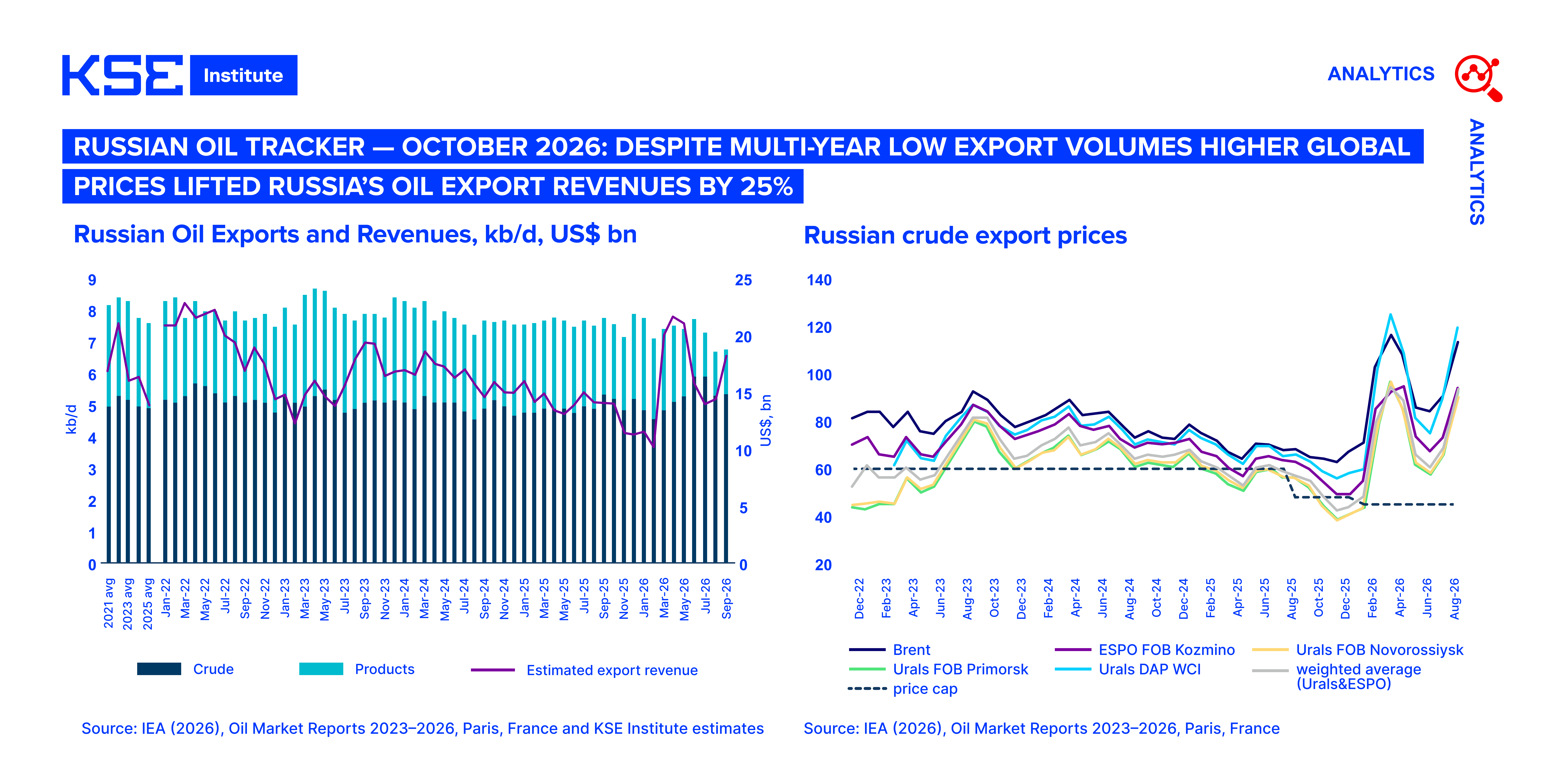
Russia’s oil export earnings rose from $14.1 billion in August to $17.7 billion in September, driven by higher prices. The average Russian oil export price climbed from $68.4 to $93.3 per barrel, while the discount to global benchmarks widened slightly to $23.6 per barrel. Total crude oil and petroleum product exports remained at 6.5 million barrels per day, their lowest level since the start of the full-scale invasion. Following the reopening of ports, crude shipments edged up from 5.2 to 5.3 million barrels per day, while petroleum product exports shrunk to a new record low of 1.2 million barrels per day due to continued refinery strikes and export bans.
According to KSE Institute’s forecast, renewed tensions in the Middle East are expected to push Brent prices to a peak of around $116 per barrel in Q4 2026, while Urals is projected to average approximately $76 per barrel in 2026 and $64 in 2027. As a result, Russia’s oil export earnings are forecast to reach $200 billion in 2026, up $42 billion from 2025, before declining to $159 billion in 2027.
Russia recorded a second consecutive monthly federal budget surplus of 614 billion rubles in September, following 602 billion rubles in August. The cumulative deficit narrowed from 5.8 trillion to 5.2 trillion rubles but already accounts for 71% of the newly approved full-year target of 7.3 trillion rubles. Over January-September, oil and gas budget revenues fell 17% year-on-year, partly because higher oil prices increased damper reimbursements. These payments reached 400 billion rubles in September. Non-oil and gas revenues rose 19%, while federal spending increased 15%. To cover its financing needs, the Ministry of Finance returned to domestic borrowing after a two-month pause, raising 1.3 trillion rubles in September – the highest monthly amount since November 2025. This brought execution of the revised 2026 domestic borrowing plan of 5.4 trillion rubles to 80%. Borrowing was heavily supported by CBR repo liquidity.
Persistent inflation continues to complicate the CBR’s efforts to ease monetary policy. Annual inflation stood at 6.3% in September, well above the central bank’s 4% target, while cumulative inflation reached 5.0%, up from 4.7% in August. Prices for medical services rose by 12.0% year-on-year, passenger transportation by 11.9%, and meat by 9.2%. Continued strikes on refineries and logistics infrastructure are already adding to price pressures and pushing up inflation expectations. Household inflation expectations reached 14.2%, while the net balance of enterprises expecting higher inflation rose to 22.7%. With inflation risks rising, the CBR paused its easing cycle in October, keeping the policy rate unchanged at 14%.
Contacts