


Russia’s oil export volumes fell to their lowest level since 2018, while higher prices pifted export revenues by just $0.3 bn
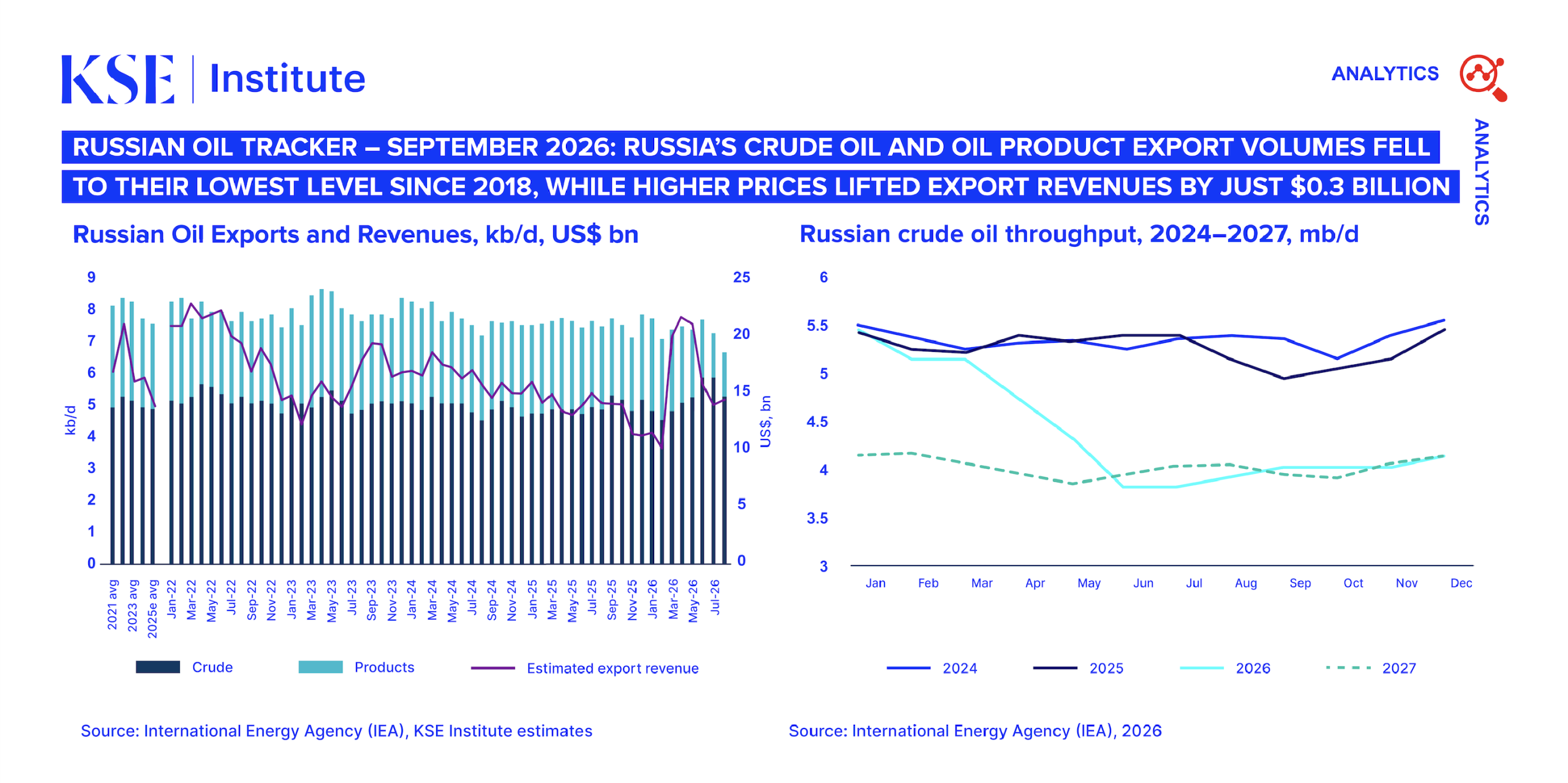
In August 2026, Russian seaborne exports of crude oil and oil products fell by 6.1% compared with July and by 12.4% year-on-year to 4.9 mb/d, according to the September edition of the KSE Institute’s Russian Oil Tracker. Crude oil shipments declined by around 9% to 3.8 mb/d. Seaborne oil product exports increased by 4.6% to 1.1 mb/d but remained approximately 50% below the 2025 average.
Total Russian crude oil and oil product exports fell by 410 kb/d compared with July and by 840 kb/d year-on-year to 6.4 mb/d – the lowest level since 2018. Higher prices partly offset the decline in export volumes. Russia’s oil export revenues increased by just $0.3 billion both month-on-month and year-on-year to $13.9 billion.Ukrainian strikes continue to weigh on Russia’s refining sector. In July, refinery throughput fell to 3.7 mb/d – its lowest level in more than 20 years, compared with installed capacity of around 6.5 mb/d. MEA expects throughput to recover only to average of around 4 mb/d for the remainder of 2026 and throughout 2027. Sanctions restricting access to spare parts and specialist equipment are hampering the restoration of damaged facilities. Russia may also extend restrictions on gasoline and diesel exports into October.
The sharpest decline in August was recorded at Black Sea ports. Crude oil exports fell by 55.9% compared with July and by 53.1% year-on-year, while oil product exports declined by 52.1% and 79.2%, respectively.
Tankers with International Group P&I insurance coverage carried 28% of Russian crude oil and 71% of oil products. KSE Institute estimates that 168 loaded shadow fleet tankers departed Russian ports or received Russian oil through ship-to-ship transfers in August, with 92% of them more than 15 years old.
As of September 25, the US, UK, EU, Canada, Australia, and New Zealand had collectively sanctioned 687 unique oil tankers. On September 24, Australia sanctioned another 38 tankers. This increased the number of vessels designated by all six jurisdictions to 49.
The share of US-designated Russian oil producers also increased in August following the global market dynamics. Rosneft, Lukoil, Gazpromneft, and Surgutneftegaz together accounted for 25% of crude oil exports, up from 15% in July, while their share of oil product exports reached 17%. The share of UAE-based Redwood Global Supply in Russian crude exports declined to 21%, while Russia-based Rusexport’s share fell to 22%, still above its 15% average in January–June 2026.
India and China remained the main buyers of Russian crude oil. India reduced imports by 24% in August to around 2 mb/d, still 18% above the 2025 average. Russian crude accounted for 43% of India’s total crude imports. China increased purchases by 18% to 1.65 mb/d, or 23% of its total crude imports. Turkey increased Russian crude imports to 204 kb/d, accounting for 34% of its total crude imports, while imports of Russian oil products fell to 127 kb/d – the lowest level observed.
In September, Russia also began shipments through a new Arctic export route. Two tankers loaded around 1 million barrels of crude at the Sever Bay Oil Terminal after it was transported through the 790-km Vankor–Payakha–Sever Bay pipeline. The initial volumes came primarily from the mature Vankor fields already connected to ESPO pipeline, while the new Payakha fields remain at an early stage of development amid sanctions. Thus, Russia made a Potemkin style show by shipping ESPO crude through a more complex and expensive export route.
Prices for Russian crude oil and oil products increased in August. Average Urals FOB prices rose by around $9/bbl to $66/bbl and remained above the revised EU price cap. ESPO FOB Kozmino increased by around $6/bbl to $73/bbl. Russian diesel traded at around $163/bbl and gasoil at $139/bbl.
KSE Institute revised its outlook for Russian oil export revenues to reflect the ongoing war in the Middle East. Under the base case, revenues could rise from $158 billion in 2025 to $193 billion in 2026 before declining to $158 billion in 2027. Under stronger sanctions pressure, revenues could amount to $166 billion in 2026 and $125 billion in 2027. Under weak enforcement, they could reach $204 billion and $197 billion, respectively. Russia’s cumulative oil export losses from March 2022 through August 2026 are estimated at $209 billion. Losses in August amounted to $4.4 billion, down $0.5 billion from July.
Contacts